What radon is
Radon is a radioactive gas that comes from the ground under your house. You cannot see it, smell it or taste it. The only way to know your level is to test.
How it gets into a house
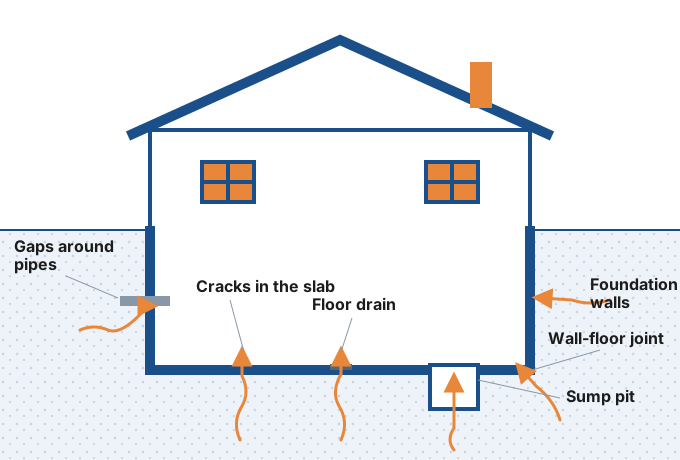
Radon forms when uranium in soil and rock breaks down. The gas moves up through the ground and into the lowest part of a house, where the air pressure is a little lower than outside. It comes in through cracks in the slab, the sump pit, floor drains, gaps around pipes and wires, crawlspaces, and the joint where the wall meets the floor. In winter, when the house is closed up and the furnace runs, more gas is drawn in and less goes out.
The Health Canada guideline
Health Canada's guideline is 200 Bq/m3, measured as a yearly average in a part of the house where people spend time. If a long-term test comes back between 200 and 600, Health Canada says fix it within two years. Above 600, within one year. Health Canada
There is no level that is zero risk. Lower is better, and the guideline is the line where Health Canada says action is worth it.
How common it is
Two houses on the same street can test very differently. Your neighbour's number does not tell you yours.
What it does
Breathing radon over years damages the lungs. Health Canada estimates that radon causes about 16% of lung cancers in Canada, more than 3,000 deaths a year. People who smoke and live with high radon carry a higher risk again. Health Canada fact sheet
Radon has no short-term symptoms. You will not cough or feel ill. That is why Health Canada asks every homeowner to test.
Ready to test or fix?
Call 807-696-2005 Use the form
Hours: 8 am to 7 pm Eastern, seven days. Outside hours, leave a message or use the form; we call back the next working morning.