


Canada
Radon testing and mitigation across Canada
Breathe safer in the home
you share with your family.
Where we work
Now serving
One city at a time, with local facts and a local number on every city page.
Thunder Bay, ON
16% of City of Thunder Bay homes tested at or above the guideline. Canada 6.9%, Ontario 4.6%. TBDHU 2014/15 city study
See Thunder Bay radon risk by wardYour city next
We add cities one at a time. Call and we will tell you if we can help where you are.
Call 807-696-2005What we do
Test first, then fix
A test tells you the number. A system brings it down. We handle both, with certified people at every step.
Radon testing
A long-term test kit sits on the lowest lived-in floor for 91 days or more, best in the heating season, then goes to a lab. Kits cost about $50 and many libraries lend digital detectors.
How testing worksRadon mitigation
A sub-slab system, put in by a C-NRPP certified installer, usually in one day. In most homes it cuts the radon level by more than 80%. We retest after to confirm it works.
How a system worksThe problem
Radon in Canadian homes
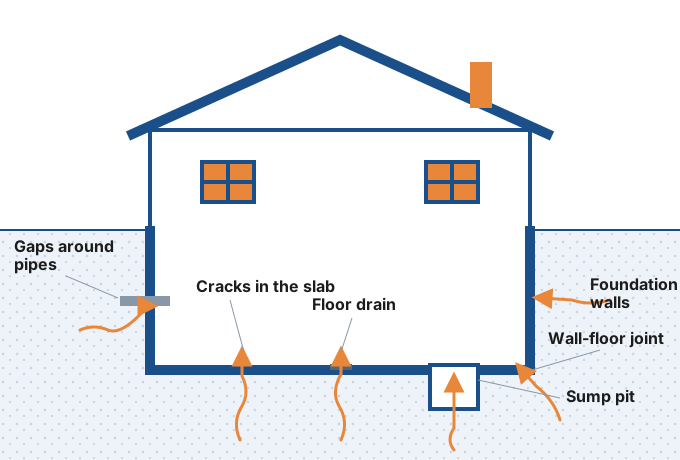
Radon is a radioactive gas. It forms when uranium in soil and rock breaks down, and it seeps into homes through cracks in the slab, the sump pit, floor drains and gaps around pipes. You cannot see it or smell it. The only way to know your level is to test.
Health Canada estimates that radon causes about 16% of lung cancers in Canada, more than 3,000 deaths a year. People who smoke and live with high radon carry a higher risk again. Health Canada fact sheet
The guideline is 200 Bq/m3 as a yearly average. Above it, Health Canada says fix it: within two years between 200 and 600, within one year above 600.
- Health Canada guideline200 Bq/m3 as a yearly average. Health Canada
- Certified installers onlyEvery installer we work with is C-NRPP certified.
- Health Canada's test methodLong-term test, 91 days or more, in the heating season.
How a radon system works
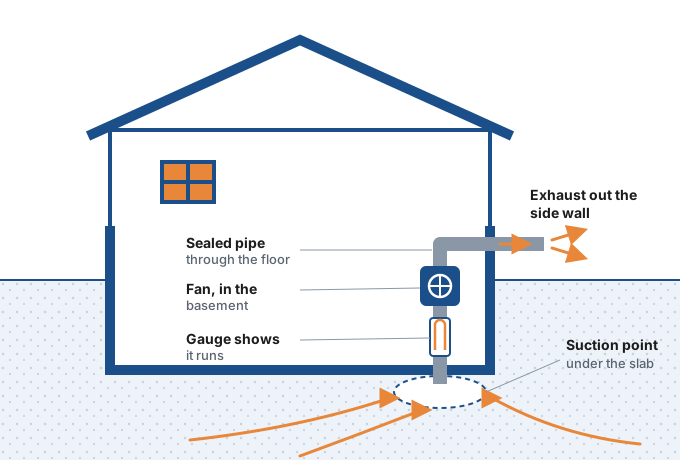
The fix is a sub-slab depressurization system. A certified installer drills a hole through the basement floor, seals a pipe into it, and runs the pipe to a fan. The fan pulls the gas from under the slab and sends it outside, usually through the side wall of the house. In some homes it runs up through the attic or garage and out above the roof. Health Canada calls this the most common method. It can be installed in less than a day, and in most homes it cuts the radon level by more than 80%. Health Canada
- Test for 91 days or more, in the heating season.
- Install the system, usually in one day.
- Retest to confirm it works. Retest again within five years and after any renovation.
FAQ
Questions people ask
How do I test my home for radon?
With a long-term kit on the lowest lived-in floor for 91 days or more, best between October and April. The kit goes to a lab and you get a number in Bq/m3. Our testing page walks through it.
Is radon mitigation loud?
The fan runs all the time and makes a low hum close to it. Installers put it in a utility room, an unfinished part of the basement, an attached garage or the attic, away from bedrooms.
How do I know an installer is certified?
Ask for the C-NRPP number and check it on the C-NRPP site. Every installer we work with is listed there.
Which cities do you serve?
Thunder Bay and district now. More cities are coming; call and we will tell you if we can help where you are.
Next step
Get a quote or book a test
Send the form and we call you back the same working day. No cost, no obligation. Prefer to talk? Call 807-696-2005.